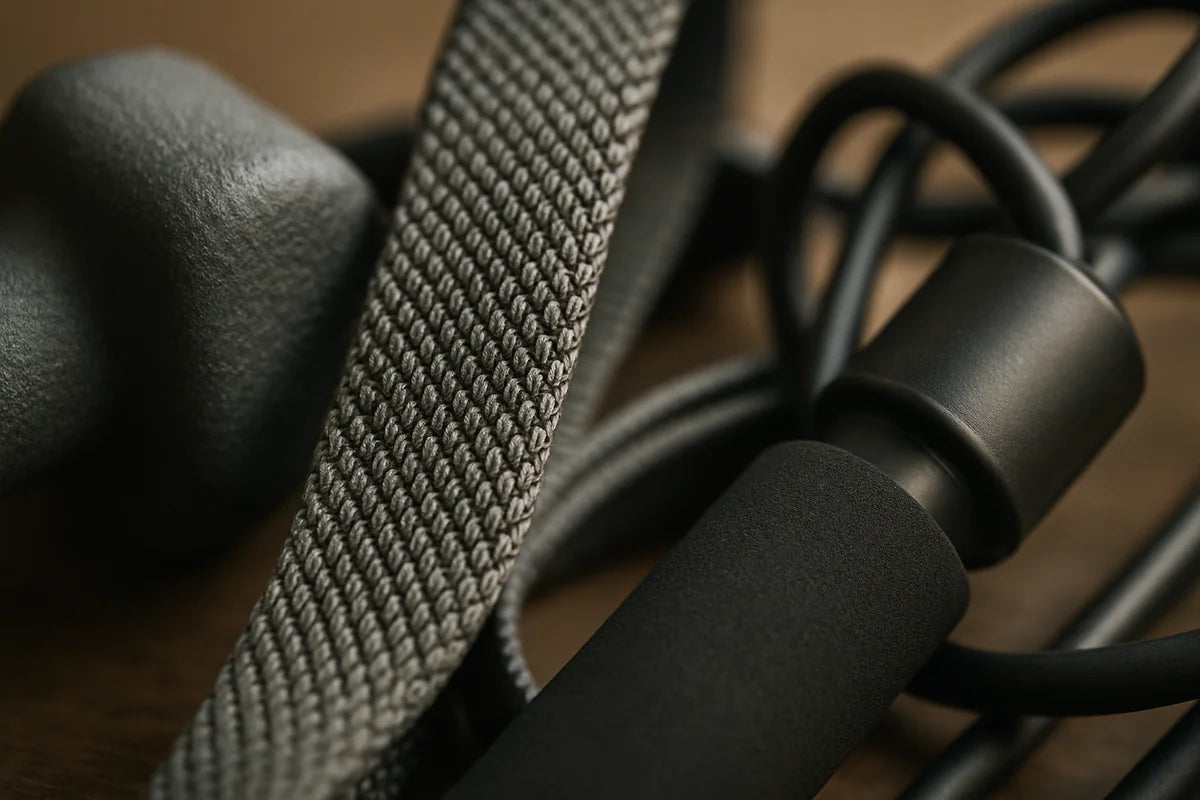
Small apartments force you to make choices. You can’t keep gear you don’t use, and you can’t waste floor space on machines that turn into laundry racks. The good news: you don’t need a big room to train well. With a smart setup, you can build strength, improve cardio, and stay mobile using home fitness equipment for small apartments that stores fast and works in tight quarters.
This article breaks down what to buy, what to skip, and how to plan a compact setup you’ll actually stick with.
Start with your space (not the gear)

Before you add anything to your cart, do a two-minute “space audit.” It keeps you from buying gear that fits your goals but not your home.
Measure the real workout area
- Pick a spot you can clear daily: beside the bed, in front of the couch, a hallway stretch, or a corner near a window.
- Measure floor space. A yoga mat area (about 2 ft x 6 ft) is enough for most strength and mobility work.
- Check ceiling height if you plan overhead presses, jump rope, or pull-up options.
Choose your “storage home” first
Every item should have a place to live when you’re not using it. If it doesn’t, it’s clutter. Good storage homes include:
- Under-bed bins for bands, sliders, and a mat
- A single closet shelf for small weights
- A wall hook for a jump rope or suspension trainer
- A narrow corner for adjustable dumbbells or a foldable bench
The best home fitness equipment for small apartments (by training goal)
The best compact gear does two things: it trains many moves and it stores small. Here’s what works, with practical notes on noise, floor space, and value.
For strength: adjustable dumbbells
If you can buy only one strength tool, make it adjustable dumbbells. They replace a whole rack and let you progress over time. Use them for squats, presses, rows, hinges, lunges, and carries.
- Why they fit apartments: one set replaces 5-15 pairs of dumbbells
- Storage: a small cradle or low shelf
- Noise tip: set them down on a mat, not bare wood
Want a strength plan that matches your time and level? The American Council on Exercise workout library has templates you can adapt to dumbbells and bands.
For strength on a budget: resistance bands (loop and tube)
Bands are cheap, quiet, and shockingly useful. They shine in small apartments because they weigh almost nothing and create resistance without dropping plates.
- Best uses: rows, presses, deadlift patterns, lateral walks, glute work, rehab-style training
- Space needs: about one mat length
- Buy tip: get a set with different tensions and one door anchor
Not sure how to program them? Many coaches use bands for strength and joint-friendly volume. Sites like Breaking Muscle often publish band workouts and variations you can plug into your week.
For pulling strength: a doorframe pull-up bar (with caution)
Pulling is hard to train at home without equipment. A doorframe pull-up bar solves that, if your doorframe can handle it.
- Best for: pull-ups, chin-ups, dead hangs, knee raises
- Apartment reality: check trim strength and doorframe depth first
- Safety: follow install directions, test slowly, and don’t use damaged frames
If you can’t do pull-ups yet, start with hangs and negatives. Grip work and hangs also support shoulder health. For more detail on resistance training principles and safe progression, the NSCA training articles are a solid reference.
For cardio without pounding: jump rope (or a quiet alternative)
Jump rope gives you a brutal workout in a tiny footprint. But it can be loud and downstairs neighbors might hate it.
- Best for: fast cardio sessions, coordination, warm-ups
- Noise fix: use a thick mat and keep jumps low
- Alternative: “shadow rope” (rope-less handles) or brisk step-ups on a stable step
If you want a simple way to track how hard your cardio should feel, check the CDC’s overview of recommended weekly activity levels and use it to set a realistic target for your schedule.
For joint-friendly cardio: compact under-desk treadmill or mini stepper
Walking is the easiest cardio to stick with, and it’s low impact. If you struggle to get outside, a compact treadmill that slides under a bed can be worth it. A mini stepper is smaller and cheaper, but it can feel repetitive.
- Best for: steady cardio, daily steps, low stress training days
- Space needs: a strip of floor, plus storage clearance
- Noise tip: use a dense mat to reduce vibration
If you want to set a step goal that matches your baseline, use a simple tool like an steps-to-calories calculator to estimate output, then adjust based on how you feel and your schedule.
For mobility and core: a mat, sliders, and one small ball
This is the “boring” gear that keeps you training. A good mat protects your knees and hands. Sliders turn push-ups, mountain climbers, and hamstring curls into real work. A small Pilates ball (or a firm cushion) helps with core control and adductor work.
- Best for: warm-ups, cooldowns, core circuits, recovery days
- Storage: under the bed or behind a door
- Cost: low, but the payoff is high
What to skip in a small apartment (most of the time)
Some gear looks good online but fails in tight spaces. Here’s what often disappoints apartment renters.
- Full-size treadmills and big ellipticals: heavy, loud, and hard to move alone
- Cheap “all-in-one” home gyms: bulky with limited resistance curves and awkward setups
- Huge weight sets with fixed dumbbells: they eat storage fast
- Anything that needs constant assembly: if setup takes 10 minutes, you’ll skip sessions
If you love one of these, you can make it work. Just be honest about storage, noise, and how often you’ll use it.
Build your kit in smart layers (so you don’t waste money)
You don’t need a full apartment gym on day one. Add gear in layers based on what you’ll use this month, not what you might use someday.
Layer 1: the “I can train anywhere” kit
- Exercise mat
- Long resistance band + mini loop band
- Jump rope or rope-less handles
This layer covers strength basics, mobility, and cardio intervals. It also fits in a backpack.
Layer 2: the strength upgrade
- Adjustable dumbbells
- Door anchor (if you use bands often)
Now you can load squats, presses, and rows in a way that drives progress.
Layer 3: comfort and variety
- Foldable bench or sturdy step (if you have space)
- Sliders
- Pull-up bar (only if your frame is solid)
Variety helps consistency, but only if it doesn’t turn your home into a storage unit.
Noise, neighbors, and floors: make your setup apartment-proof
Training at home should not start a feud. A few small choices keep things quiet and protect your floors.
Use the right mat (not just any yoga mat)
- For strength work: use a thicker, denser exercise mat or interlocking foam tiles
- For cardio equipment: use a vibration-damping mat under the machine
- For jump rope: combine a mat with low, soft jumps
Pick “quiet strength” moves
- Swap jump squats for slow goblet squats
- Swap burpees for step-back burpees or incline burpees on a couch
- Do carries and marches instead of sprints in place
Train at neighbor-friendly times
If your building has thin floors, schedule the louder work for midday. Save mobility, strength, and steady walking for early mornings or later evenings.
Sample small-space workouts (minimal gear, real results)
These sessions use common home fitness equipment for small apartments. They work in a mat-sized area. Adjust reps to keep good form.
Workout A: full-body strength (dumbbells)
- Goblet squat: 3 sets of 8-12 reps
- One-arm row (brace on thigh or couch): 3 sets of 8-12 reps each side
- Dumbbell floor press: 3 sets of 8-12 reps
- Romanian deadlift: 3 sets of 8-12 reps
- Suitcase carry (walk your hallway): 4 trips of 20-40 steps each side
Workout B: full-body strength (bands + bodyweight)
- Band row (door anchor): 3 sets of 10-15 reps
- Push-ups (hands on couch if needed): 3 sets of 6-15 reps
- Band deadlift: 3 sets of 10-15 reps
- Split squat: 3 sets of 8-12 reps each side
- Pallof press (band): 3 sets of 10-12 reps each side
Workout C: quiet cardio + core (no jumping)
- March in place with high knees: 5 minutes, steady pace
- Step-ups on a stable step/couch edge: 10 minutes, switch lead leg often
- Slider mountain climbers: 6 rounds of 20-30 seconds work, 30-40 seconds rest
- Side plank: 3 sets of 20-40 seconds each side
If you want to balance strength and cardio across the week, the Mayo Clinic has a clear overview of how to build an exercise plan you can adapt to a small-space routine.
How to choose equipment you’ll actually use
Most people don’t fail because they picked “bad” gear. They fail because the gear doesn’t match their habits.
Ask three questions before you buy
- Will I use this at least twice a week?
- Can I set it up in under one minute?
- Do I have a storage home for it?
Choose gear that supports progression
You don’t need fancy gear. You need a way to make training harder over time. Look for at least one of these:
- More load (heavier dumbbells, thicker bands)
- More reps or sets
- Harder variations (split squats to Bulgarian split squats, incline push-ups to floor push-ups)
- Shorter rest times
Don’t ignore comfort
If your wrists hurt on push-ups, you’ll avoid them. If your knees hate thin mats, you’ll skip floor work. Comfort isn’t a luxury. It’s part of consistency.
Where to start this week
Pick one corner of your apartment and claim it. Clear enough space for a mat. Then choose one small gear layer and run it for two weeks. Keep it simple:
- 2 strength sessions (Workout A or B)
- 2 cardio sessions (Workout C or a brisk walk session)
- 5-10 minutes of mobility on the days between
After two weeks, you’ll know what you’re missing. Maybe it’s heavier resistance. Maybe it’s a better mat. Maybe it’s a pull-up option. Add one item that solves your real problem, not the one an ad invented.
Small spaces don’t block progress. They force focus. When you choose home fitness equipment for small apartments with a clear plan, your workouts stop competing with your living room and start fitting into your life.
Share:
How to Create a Balanced Workout Plan for New Moms (Without Burning Out)
Grip Strength for Parkour: Build Hands That Don’t Quit