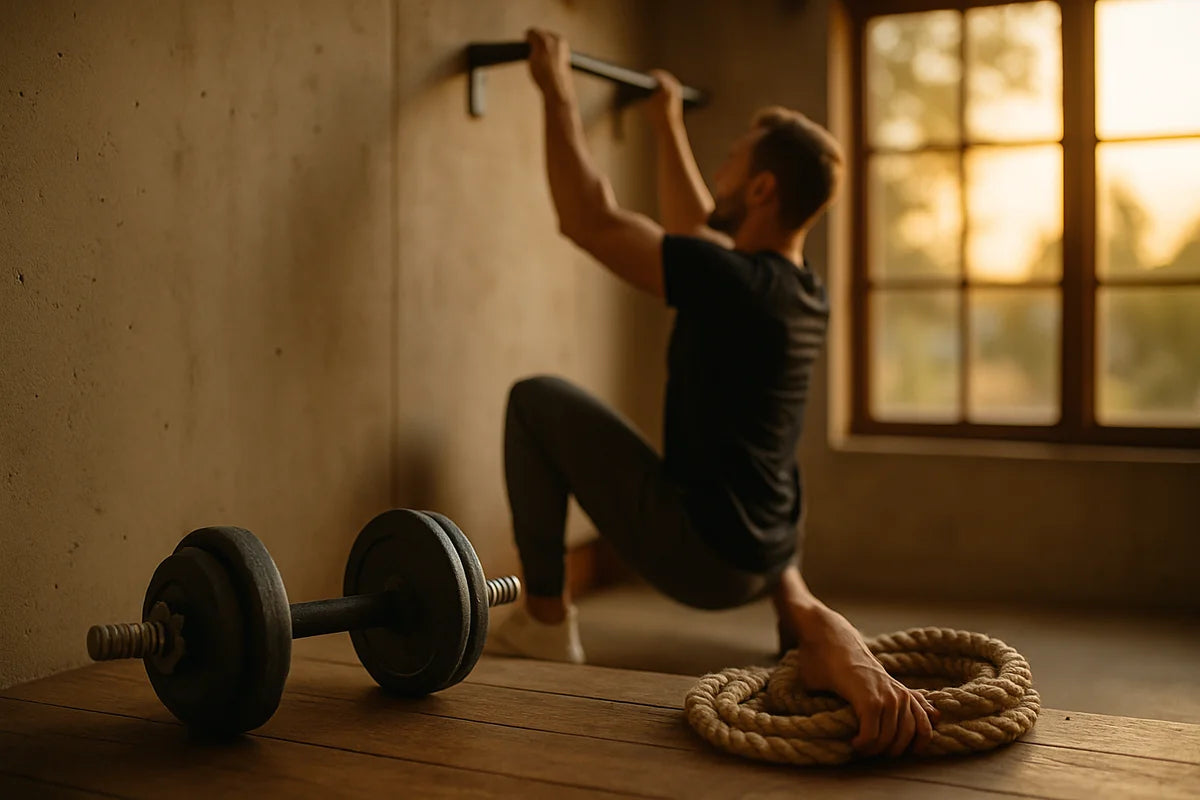
If you do parkour long enough, your legs will get strong. Your lungs will catch up. Your timing will sharpen. But your grip can still end a run fast. A wet rail, a rough wall, a tired forearm on a cat leap, and suddenly you’re sliding, not sticking.
The good news: you can train grip strength for parkour in a way that carries over to real moves. Not just “strong hands,” but the mix of finger strength, wrist control, and forearm endurance that lets you hang on, pop up, and keep moving.
What “grip strength” means in parkour (it’s not one thing)

When people say “increase grip strength,” they often mean crushing strength, like squeezing a hand gripper. That helps a little, but parkour asks for more. You’ll get better results when you train the main grip types you actually use.
The grip types you use most
- Support grip: holding your body weight on a bar, rail, or wall edge (hangs, swings, cat hangs).
- Pinch grip: squeezing with thumb and fingers (wide ledges, some wall edges, grabbing blocks).
- Open-hand strength: fingers extended more than curled (slopers, rounded rails, awkward edges).
- Finger strength: high tension through the fingertips (small ledges, precise catches).
- Grip endurance: staying strong after 30-90 seconds of work (long routes, repeated vaults, climb-ups).
Parkour grip is also about position. If your wrist collapses or your shoulders shrug up, your hands do extra work and gas out sooner.
Quick self-test: what’s your weak link?

Before you add more training, find the limiter. Try these simple checks once a week for three weeks. Use the same setup each time.
- Dead hang test: hang from a pull-up bar with shoulders active (not a limp hang). Stop when your grip fails. Note time.
- Towel hang test: drape two towels over a bar and hang holding the towel ends. This hits crush strength and endurance. Note time.
- Single-arm support feel: do a supported one-arm hang (feet on a box) and see if one side fails early.
- Wrist position check: in a hang, can you keep wrists neutral and shoulders down, or do you bend wrists and shrug?
If your towel hang is far worse than your bar hang, your “crush” endurance lags. If both are low, you likely need more basic time under tension. If wrists or elbows ache, you need smarter loading, not more grinding.
For general strength benchmarks and safe loading ideas, the American Council on Exercise training resources give solid, practical guidance on progression.
How to increase grip strength for parkour: the training priorities
Most people improve fastest when they follow three priorities:
- Get strong at hanging first (support grip and shoulder control).
- Add finger strength second (carefully, since tendons adapt slow).
- Build endurance last (so you can keep quality under fatigue).
If you skip the first step and jump to hard finger work, you might gain strength for a few weeks and then hit elbow or finger pain. Parkour already gives you impact and volume. Your grip work should balance that, not add chaos.
The core moves that carry over to real parkour
1) Active hangs (your base layer)
If you only do one grip drill, do active hangs. They train support grip, scapular control, and the habit of “owning” a hold.
- How: hang from a bar, pull your shoulders down and slightly back, keep ribs down, breathe.
- Start: 3-5 sets of 15-30 seconds.
- Progress: add time, then add load (light backpack), then add movement (small shoulder taps).
Want a clear explanation of why shoulder position matters in hanging strength? The Physio-Pedia overview of scapular control connects the dots between shoulder mechanics and safe loading.
2) Towel hangs and towel pull-ups (rail realism)
Towels mimic thick rails and odd textures. They also force your hands to work without perfect bar friction.
- Beginner: 4 sets of 10-20 second towel hangs.
- Intermediate: towel hang + knee raises (3 sets of 6-10 reps).
- Advanced: towel pull-ups (3-5 sets of 3-6 reps).
Keep reps clean. If you start swinging and yanking, your elbows take the bill.
3) Farmer carries (grip plus trunk stability)
Parkour doesn’t happen in a dead hang only. You run, turn, and brace. Carries train grip while your trunk stays tight, which helps when you land and grab right after.
- How: hold heavy dumbbells, kettlebells, or loaded buckets. Walk tall, slow, and controlled.
- Start: 4 trips of 20-30 meters.
- Progress: heavier weight, longer distance, or one-sided carries.
For more carry variations and programming ideas, see StrongFirst articles on loaded carries (simple methods, no fluff).
4) Deadlifts and rows (the “hidden” grip builders)
If you already lift, you can build grip strength without adding extra sessions. Heavy pulls force your hands to adapt.
- Do deadlifts, Romanian deadlifts, barbell rows, or heavy dumbbell rows.
- Avoid straps for most sets if grip is your goal (use straps only when grip limits your back training).
- Try a 10-20 second hold at the top of the last set.
Strength standards vary, but basic barbell work can build a big base. For general strength training guidelines, NSCA education resources are a reliable reference.
5) Finger training: start smaller than you want
Finger strength matters for cat hangs, small ledges, and sketchy catches. But finger tendons adapt slower than muscles. Go slow and treat finger work as skill practice, not a test of toughness.
If you have a hangboard, keep it simple. If you don’t, use a sturdy doorframe edge (only if safe), a thick book edge clamped securely, or a campus rung at a gym.
- Beginner protocol: 6-8 sets of 7-10 second hangs on a comfortable edge with plenty of rest (60-90 seconds).
- Rule: stop with 2-3 seconds “in the tank.” No shaking to failure.
- Frequency: 1-2 times per week.
If you want evidence-based hangboard structure and why short hangs work, UKClimbing’s hangboard strength article lays out sensible progressions that also fit parkour needs.
6) Wrist and forearm balance work (to keep elbows happy)
Parkour has a lot of gripping and impact. If you only train flexion (closing the hand) and never train the other side, you can earn classic overuse pain near the elbow.
- Wrist extensions: light dumbbell, 2-3 sets of 15-25 reps.
- Reverse curls: 2-3 sets of 10-15 reps.
- Pronation/supination: rotate a light hammer or dumbbell, 2-3 sets of 10-15 per side.
This isn’t flashy. It works because it keeps the joint tolerant to the hours you spend hanging, vaulting, and catching.
Programming: two simple weekly plans
You don’t need daily grip work. You need steady work that doesn’t wreck your parkour sessions. Here are two options depending on how much you train.
If you do parkour 2-3 days per week
- Day A (after parkour or separate): active hangs 4x20-30s, farmer carries 4x25m, wrist extensions 2x20
- Day B (after parkour or separate): towel hangs 5x15-20s, row variation 3x8-12, pronation/supination 2x12
- Optional Day C (light): finger hangs 6x8s, easy scap pulls 2x10
If you do parkour 4+ days per week
- Keep grip work short: 2 focused sessions per week, 15-25 minutes each.
- Session 1: active hangs + carries.
- Session 2: towel hangs + finger hangs (only if fingers feel fresh).
If you train hard outside, your grip already gets volume. Your extra work should fill gaps, not pile on fatigue.
Technique tweaks that give you “free” grip
Sometimes the fastest way to increase grip strength for parkour is to stop wasting it. A few position fixes can add seconds to every hang.
Set your shoulders before you load your hands
On a rail or wall, don’t jump to a shrug. Pull shoulders down, pack them, then load. This spreads force through the back, not just forearms.
Use friction smart
- Chalk helps when sweat is the issue. Use a little, not a cloud.
- Clean rails when you can. Dust and grit cut friction fast.
- Train in different weather sometimes, but don’t make every session a suffer fest.
For practical chalk and skin care tips from people who live on holds, Metolius climbing resources have straightforward advice that transfers well to parkour.
Catch with intent, not panic
When you grab a rail on a stride or lache, aim to “close” the grip fast and lock the wrist. If you slap and then squeeze late, your fingers take a shock load and slip more.
Common mistakes that stall grip gains
Going to failure every set
Failure has a place, but it’s a bad default for tendons. Most of your grip work should stop just short of breakdown. You’ll recover faster and train more often.
Ignoring recovery signs
Watch for these:
- Finger joint soreness that lasts more than 24-48 hours
- Sharp pain on the inside or outside of the elbow
- Loss of grip “snap” even after a warm-up
If that shows up, reduce volume for a week, keep light wrist work, and shift focus to technique and legs.
Only training one grip angle
If you always hang from the same bar, you build strength in one hand shape. Add variety:
- Thick grips (towels, fat bar attachments)
- Different rail sizes
- Neutral grip (rings) and overhand grip (bar)
Parkour-specific conditioning: build grip endurance without boredom
Want grip that lasts through a full line? Add short circuits that keep quality high.
Simple “route” circuit (10-12 minutes)
- Active hang: 20 seconds
- Bear crawl: 20 meters
- Precision jumps: 6 reps (easy distance)
- Rest: 60 seconds
- Repeat 4-5 rounds
This keeps your hands working while you move. It also teaches you to grip under a raised heart rate, which is where parkour grip often fails.
How long it takes (and what progress looks like)
You can feel better in 2-3 weeks, mostly from better shoulder position and more efficient holds. Real tissue changes take longer. Plan on 8-12 weeks of steady work to see clear, repeatable gains in hang time, towel strength, and confidence on rails.
Track one or two numbers, not ten:
- Active hang time
- Towel hang time
- How many clean cat hang re-grips you can do without slipping
Next steps: build hands that match your lines
Pick two grip sessions per week and run them for a month. Keep them short, keep them clean, and don’t chase failure. As your hang time climbs, start practicing more real holds: rails, walls, and awkward edges in safe settings. Film a few catches and check your shoulders and wrists. Small fixes there can feel like a strength upgrade overnight.
Grip strength for parkour isn’t a party trick. It’s a base. Build it now, and the lines you avoid today will start to look realistic, not risky.
Share:
Small Apartment, Strong Body: Home Fitness Equipment That Fits and Gets Used
Wall-Mounted Pull-Up Bar in a Small Apartment: How to Install It Without Wrecking Your Walls