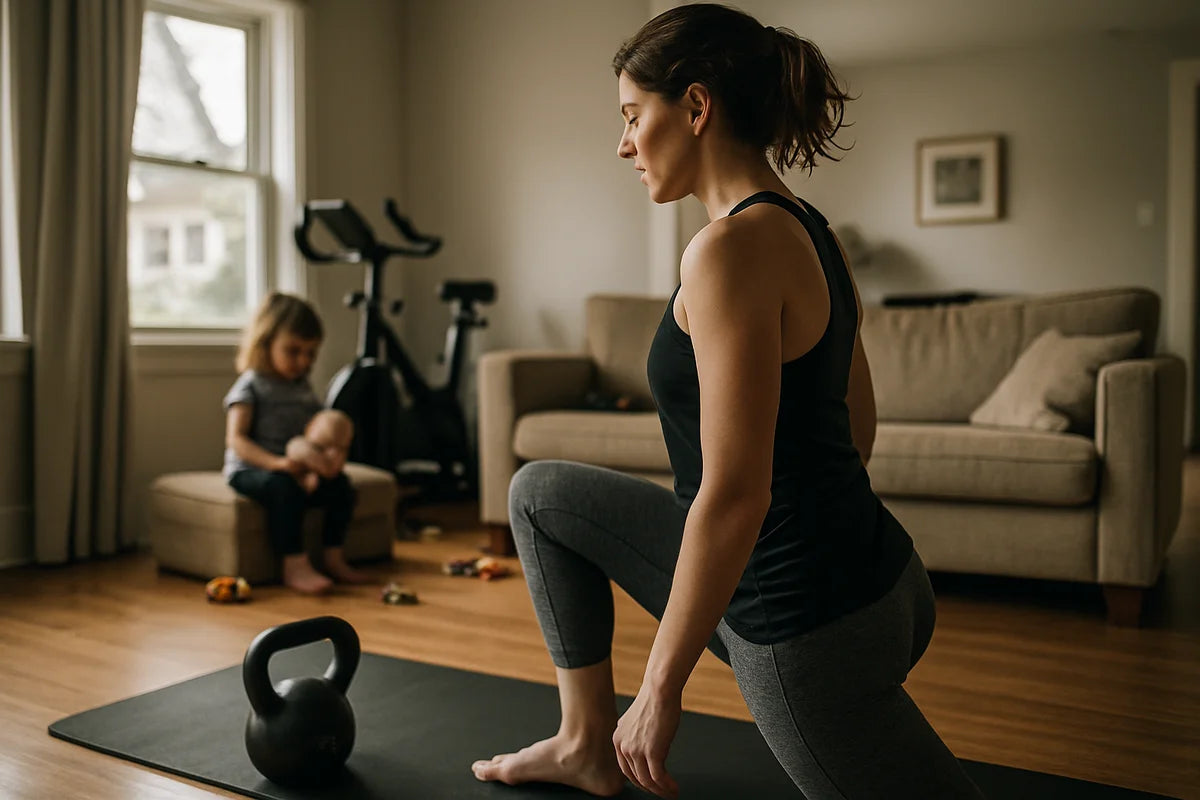
You don’t need a perfect schedule, a spare hour, or a home gym to get fit. You need a plan that works when the baby woke up early, the school run ran late, and dinner still has to happen. This is where effective workout routines for busy moms transitioning to fitness matter most: short sessions, simple moves, and a structure you can repeat without thinking.
This article gives you routines you can start this week, plus ways to scale them as your strength and stamina return. You’ll get options for 10, 20, and 30 minutes, ideas for building consistency, and tips to stay safe if you’re postpartum or coming back after a long break.
What “effective” really means when you’re a busy mom

Effective doesn’t mean crushed. It means you can do it again tomorrow.
- It fits your day: you can finish it before the next task steals your time.
- It builds your base: strength, joint health, and cardio that supports daily life.
- It respects recovery: soreness shouldn’t wreck your sleep or your mood.
- It’s clear: you shouldn’t waste minutes deciding what to do.
If you’re transitioning to fitness, the first win is consistency. The second win is progress you can measure without getting obsessive.
Start with a simple safety check (especially postpartum)

If you had a baby recently, listen to your body and get medical guidance when needed. Some moms can ease in within weeks, others need more time. If you have pelvic heaviness, leaking, pain, or doming along your midline during core work, pause and get help from a pelvic health pro.
These resources can help you gauge what’s normal and when to ask for support:
Not postpartum? The same rule applies: pain that changes how you move is a stop sign. Soreness is normal. Sharp pain isn’t.
The building blocks: strength, cardio, and mobility (in small doses)
The best effective workout routines for busy moms transitioning to fitness use a few basics and repeat them. You don’t need 30 different exercises. You need the right ones.
Strength: your “carry the groceries” foundation
Strength training pays off fast in daily life: lifting kids, hauling laundry, standing longer without aches. Full-body strength 2-4 times per week works well for most beginners.
If you want a plain-language overview of strength training basics, ACE fitness education articles offer solid starting points.
Cardio: heart health without long sessions
You can build cardio with brisk walking, short intervals, or circuit training. You don’t have to run if you hate running.
For weekly activity targets, CDC physical activity guidelines give clear ranges. If those numbers feel big right now, treat them as a direction, not a demand.
Mobility: keep your joints happy
Mobility doesn’t need its own hour. Five minutes of hips, ankles, and upper back work can make strength moves feel better and help you stay consistent.
The 10-minute routines (for the days that blow up)
Ten minutes counts. Done with focus, it’s enough to maintain the habit and build momentum.
Routine A: 10-minute strength reset (no equipment)
Set a timer for 10 minutes. Cycle through these moves at a steady pace. Rest when you need to, then continue.
- Squat to a chair (or bodyweight squat)
- Incline push-up (hands on counter, couch, or wall)
- Hip hinge (good morning) with hands on hips
- Dead bug (slow, controlled) or heel taps if dead bug feels too hard
Goal: move well, not fast. If you’re new, aim for 2 rounds. If you’ve been at it a few weeks, aim for 3 rounds.
Routine B: 10-minute brisk walk intervals (stroller-friendly)
- 2 minutes easy walk
- 6 rounds: 30 seconds brisk, 30 seconds easy
- 2 minutes easy walk
Brisk means you can talk in short sentences. If you can sing, pick up the pace. If you can’t speak at all, back off.
The 20-minute routines (the sweet spot for most moms)
Twenty minutes is long enough to train, short enough to fit between real tasks. If you can do three 20-minute sessions per week, you’ll see change.
Routine C: 20-minute full-body circuit (dumbbells optional)
Warm up for 3 minutes: march in place, arm circles, hip circles, and 5 slow squats.
Then do 3 rounds. Work for 40 seconds, rest for 20 seconds per move:
- Squat (hold a dumbbell at your chest if you have one)
- One-arm row (use a dumbbell, a loaded backpack, or a milk jug)
- Glute bridge (pause 1 second at the top)
- Overhead press (light weight, slow reps) or pike push-up to a couch
- Suitcase carry march (hold weight on one side and march in place)
Finish with 2 minutes of easy walking and deep breaths.
Routine D: 20-minute “strength then sweat”
This works well when you want both strength and cardio without a long session.
- 8 minutes strength: alternate 8 goblet squats and 8 incline push-ups. Do as many quality rounds as you can.
- 8 minutes cardio: alternate 30 seconds fast (march, step-ups, bike) and 30 seconds easy.
- 4 minutes core and mobility: side plank (20 seconds each side), then hip flexor stretch and thoracic rotations.
Keep the strength part controlled. Earn speed in the cardio part.
The 30-minute routines (when you can plan ahead)
Thirty minutes lets you add a bit more volume, which helps muscle tone and endurance. Two 30-minute workouts a week can work just as well as three shorter ones, if that’s what your schedule allows.
Routine E: 30-minute strength (simple, repeatable)
Warm up 5 minutes: easy walk or march, then 10 bodyweight hinges and 10 wall push-ups.
Then do 3 sets of each pair (rest 60-90 seconds between sets):
- Pair 1: squat (8-12 reps) + row (8-12 reps)
- Pair 2: Romanian deadlift with dumbbells or backpack (8-12 reps) + incline push-up (6-12 reps)
- Pair 3: split squat or reverse lunge (6-10 reps each side) + dead bug (6-10 reps each side)
Choose a weight that leaves 1-2 good reps in the tank. That keeps progress steady without crushing you.
Routine F: 30-minute low-impact cardio + mobility (great on tired days)
- 20 minutes steady cardio: brisk walk, cycling, or a low-impact video at a pace you can sustain.
- 10 minutes mobility: calves, hip flexors, glutes, upper back rotations, and chest opening stretches.
Want a quick way to estimate a safe starting calorie range if weight loss is part of your plan? Use a tool like the Calorie Calculator, then adjust based on energy, hunger, and results over a few weeks.
How to build a weekly plan that doesn’t fall apart
A schedule only works if it matches your life. Here are three patterns that fit most families.
Option 1: The “minimum effective week” (great for brand new starters)
- 2 strength sessions (20-30 minutes)
- 2 short walks (10-20 minutes)
- Daily 5-minute mobility snack
Option 2: The “three and three”
- 3 strength circuits (20 minutes)
- 3 cardio sessions (10-20 minutes, stroller counts)
- 1 full rest day or gentle walk only
Option 3: The “weekend anchor”
- 1 longer workout on Saturday or Sunday (30-45 minutes)
- 2 short strength sessions during the week (10-20 minutes)
- Walking breaks whenever you can grab them
Pick one option and run it for four weeks. Don’t keep changing the plan. You’re training consistency as much as muscle.
Progress without burnout: the simplest system that works
If you’re transitioning to fitness, progress should feel calm. Use one or two of these levers at a time:
- Add reps: keep the weight the same and do 1-2 more reps per set.
- Add load: increase weight by the smallest jump you have.
- Add a round: go from 2 rounds to 3 rounds on a circuit.
- Shorten rest a little: only if form stays solid.
Track one thing: reps, weight, or rounds. A note on your phone works.
Common sticking points (and how to beat them)
“I miss workouts when the kids get sick or sleep falls apart.”
Plan for it. Keep a 10-minute routine as your fallback. If you do that twice in a rough week, you kept the habit alive. That’s a win.
“I don’t know how hard to push.”
Use a simple effort scale from 1-10. Most sessions should feel like a 6-8. You should finish feeling worked, not wrecked.
“I get bored.”
Don’t swap the whole plan. Swap one move. Change goblet squats to step-ups. Change rows to band pull-aparts. Keep the structure.
“My wrists or knees hurt.”
Change the angle and range. Do incline push-ups instead of floor push-ups. Squat to a box or chair. If pain sticks around, get a coach or clinician to look at form.
If you want smart training ideas without hype, Stronger by Science articles break down what works in clear terms.
Make it easier: small setup changes that save workouts
- Keep gear visible: a mat, a band, and one pair of dumbbells in a corner beats a fancy setup you never use.
- Set a workout trigger: after school drop-off, right before a shower, or during one show episode.
- Use the “two-day rule”: don’t miss twice in a row. If you miss today, do 10 minutes tomorrow.
- Lower the start bar: tell yourself you only have to do the warm-up. You’ll often keep going once you start.
Where to start this week
If you want a clean starting point, do this for the next 7 days:
- Pick two days for Routine C (20-minute full-body circuit).
- Pick two days for Routine B (10-minute walk intervals).
- On the other days, do 5 minutes of mobility or an easy walk.
Then look ahead one month. If you can complete 8-10 workouts in the next four weeks, you’re no longer “trying to start.” You’re training. From there, you can add load, add rounds, or move up to the 30-minute routine on days you have more time.
Effective workout routines for busy moms transitioning to fitness don’t ask for perfection. They ask for a repeatable plan you can live with. Start small, keep it simple, and let the next month build on the last.
Share:
New Army Fitness Test Score Chart: How to Read It, Train for It, and Track Your Progress
ACFT Standards: What You Need to Pass, and How to Train for Them